House Windsor: Take note. A challenger approaches.
Schoolgirl discovers ‘Excalibur’ sword in lake from Arthur legend
A schoolgirl will have quite a story to tell when she returns to the classroom – after discovering a sword in the same lake King Arthur’s legendary Excalibur was thrown.
Matilda Jones, aged seven, from Doncaster, found the sword when she was paddling in Dozmary Pool, in Cornwall with her dad, Paul.
Paul, aged 51, had told Matilda and her sister Lois, four, about the legend of King Arthur on their journey to the lake.
He said: “It was a blistering hot day and Matilda asked if we could go for a paddle.
“She was only waist deep when she said she could see a sword.
“Strange women lyin’ in ponds…” and other Dennis the Anarcho-cynical (not a typo) Mud-Farmer quotes notwithstanding, I’d like to think the Lady of the Lake would select the new “Rightwise King(Monarch) Born of All England” by providing something better than a mass-produced and discontinued Spanish SLO.
Maybe this was a trial (though not dry) run – if so, Matilda and her Dad should get back to Cornwall / Kernow ASAP.
Although
on second thoughts, last time a Matilda laid claim to the English
throne there was civil war and anarchy. In fact there was THE Anarchy, which made for a good novel by George Shipway (”Knight in Anarchy”, what a surprise) but by all accounts wasn’t a lot of fun otherwise.
(The “rightwise king born of all England” business was on the Sword in the Stone (and anvil, everyone forgets the anvil) which apparently wasn’t Excalibur at all. A war memorial, perhaps, as T. H. White suggested. What the Lady of the Lake was waving about was a different sword entirely, and the really important bit was its scabbard, which granted invulnerability, or undefeatability, or a reliable broadband signal 24/7…)
Maybe the one in Dozmary Pool was lost during some Arthurian re-enactment – or maybe it was deliberately chucked away by someone who’d hoped for something better on their birthday, because when I saw what Matilda found…
…I recognised it as this…
…from here.
Noble Collection sells movie merchandise nowadays, but back then they sold decorative wall-hangers (SLOs – sword-like objects – is the less kindly term) made by Marto of Toledo among others, with frequently-spiky fantasy blades, ornate cast pot-metal handles and ooh-shiny! gold plating. However their version of “Excalibur" – it’s there on the cover – looked sensible enough to feature in the TV movie “The Librarian”.
Though the catalogue calls the
sword found by Matilda
a “medieval two handed sword” it’s based, more or less, on a Renaissance “Federschwert” sparring blunt (the flare above the guard was balance-compensation for not having a full-width blade.)
Here’s a real one.
Not especially Arthurian, whether Arthur was Clive Owen’s Romano-Sarmatian, Oliver Tobias’s Dark Age Celt or Nigel Terry’s High Middle Ages Anglo-Brit.
Apparently there are now also synthetic Federschwert from various sources.
At least they won’t rust when chucked into ponds. The Lady of the Lake likes low maintenance as much as anyone else…
…A little while before dinnertime this groan of “Oh, GAWD” came
from upstairs. Then the sounds of the bookshelves being ransacked, and
more mutters of “Why couldn’t it have been something nice in the water for her…”
(sigh) Another day in Sword Central.
sword tumblr lies sleeping beneath the hills, awaiting a time of great need
remember that white america hated the bus boycotts and the lunch counter sit-ins. the people saying we should be peaceful, but complain about kaepernick want us to shut up, suffer, and die. that’s all there is to it.
I guess I had so completely absorbed the prevailing wisdom that I expected people in bankruptcy to look scruffy or shifty or generally disreputable. But what struck me was that they looked so normal.
The people appearing before that judge came in all colors, sizes, and ages. A number of men wore ill-fitting suits, two or three of them with bolero ties, and nearly everyone dressed up for the day. They looked like they were on their way to church. An older couple held onto each other as they walked carefully down the aisle and found a seat. A young mother gently jiggled her keys for the baby in her lap. Everyone was quiet, speaking in hushed tones or not at all. Lawyers – at least I thought they were lawyers – seemed to herd people from one place to another.
I didn’t stay long. I felt as if I knew everyone in that courtroom, and I wanted out of there. It was like staring at a car crash, a car crash involving people you knew.
Later, our data would confirm what I had seen in San Antonio that day. The people seeking the judge’s decree were once solidly middle-class. They had gone to college, found good jobs, gotten married, and bought homes. Now they were flat busted, standing in front of that judge and all the world, ready to give up nearly everything they owned just to get some relief from the bill collectors.
As the data continued to come in, the story got scarier. San Antonio was no exception: all around the country, the overwhelming majority of people filing for bankruptcy were regular families who had hit hard times. Over time we learned that nearly 90 percent were declaring bankruptcy for one of three reasons: a job loss, a medical problem, or a family breakup (typically divorce, sometimes the death of a husband or wife). By the time these families arrived in the bankruptcy court, they had pretty much run out of options. Dad had lost his job or Mom had gotten cancer, and they had been battling for financial survival for a year or longer. They had no savings, no pension plan, and no homes or cars that weren’t already smothered by mortgages. Many owed at least a full year’s income in credit card debt alone. They owed so much that even if they never bought another thing – even if Dad got his job back tomorrow and Mom had a miraculous recovery – the mountain of debt would keep growing on its own, fueled by penalties and compounding interest rates that doubled their debts every few years. By the time they came before a bankruptcy judge, they were so deep in debt that being flat broke – owning nothing, but free from debt – looked like a huge step up and worth a deep personal embarrassment.
Worse yet, the number of bankrupt families was climbing. In the early 1980s, when my partners and I first started collecting data, the number of families annually filing for bankruptcy topped a quarter of a million. True, a recession had hobbled the nation’s economy and squeezed a lot of families, but as the 1980s wore on and the economy recovered, the number of bankruptcies unexpectedly doubled. Suddenly, there was a lot of talk about how Americans had lost their sense of right and wrong, how people were buying piles of stuff they didn’t actually need and then running away when the bills came due. Banks complained loudly about unpaid credit card bills. The word deadbeat got tossed around a lot. It seemed that people filing for bankruptcy weren’t just financial failures – they had also committed an unforgivable sin.
Part of me still wanted to buy the deadbeat story because it was so comforting. But somewhere along the way, while collecting all those bits of data, I came to know who these people were.
In one of our studies, we asked people to explain in their own words why they filed for bankruptcy. I figured that most of them would probably tell stories that made them look good or that relieved them of guilt.
I still remember sitting down with the first stack of questionnaires. As I started reading, I’m sure I wore my most jaded, squinty-eyed expression.
The comments hit me like a physical blow. They were filled with self-loathing. One man had written just three words to explain why he was in bankruptcy:
Stupid. Stupid. Stupid.
When writing about their lives, people blamed themselves for taking out a mortgage they didn’t understand. They blamed themselves for their failure to realize their jobs weren’t secure. They blamed themselves for their misplaced trust in no-good husbands and cheating wives. It was blindingly obvious to me that most people saw bankruptcy as a profound personal failure, a sign that they were losers through and through.
Some of the stories were detailed and sad, describing the death of a child or what it meant to be laid off after thirty-three years with the same company. Others stripped a world of pain down to the bare facts:
Wife died of cancer. Left $65,000 in medical bills after insurance. Lack of full-time work – worked five part-time jobs to meet rent, utilities, phone, food, and insurance.
They thought they were safe – safe in their jobs and their lives and their love – but they weren’t.
I ran my fingers over one of the papers, thinking about a woman who had tried to explain how her life had become such a disaster. A turn here, a turn there, and her life might have been very different.
Divorce, an unhappy second marriage, a serious illness, no job. A turn here, a turn there, and my life might have been very different, too.
– A Fighting Chance by Elizabeth Warren, pg. 34 – pg. 36
(Bolding mine)
I don’t want to derail this too hard. And I am terrifyingly, shakingly conscious that I live in the UK, with its mildly-socialist leanings and socialised healthcare and council houses for homeless families, and I know in my head that even if the locusts come for everything I have, if I just stay on this particular piece of land, I will be able to keep the baby alive –
I don’t want to derail too hard, but when people ask “why aren’t young people getting houses and babies” and so on: look at this post, the raw terror of this post. The reality of the locusts. The facial markings on the face of the wolf at the door.
Young people today, like the people of the Great Depression and the World-Wars-In-The-Arena-Of-Combat, know that these things can be taken away. Just. Wiped off the map.
A turn here, a turn there, and your life is over and your game is done, and you have to stand there in your shame, having lost everything.
So the response to that is: have nothing, and you can’t lose everything.
I can see the appeal.
But I wonder how deep in our hearts this nihilism can get. What its impacts will be. How can we plan for the future of the planet, when our brains can only focus on the £300 on our credit card, and panic.
What did this do to us? The children of the bankruptcy. The kids raised in this religion. can we make ourselves okay.
The most lingering comment I ever heard someone make about Millennials was an older man I was talking to about the way we think about finances–when he dreamed about being a millionaire as a young man, he talked about yachts and mansions and trips to the Bahamas; when I did, I talked about living debt-free and being able to buy dinner out without looking at my monthly budget. He heard me out, took me seriously.
And at the end of it all, he nodded and looked at me and asked, “Do you know who you remind me of?”
And I said no, no I didn’t, and he nodded some more.
“My mother. She grew up just before the Depression hit, and she saw people lose everything left and right. And whenever she talked about finances, she sounded just like you.” He paused for a moment, and said, “I never really thought about what growing up like that would do to a generation.”
He still brings that conversation up, years later. He hasn’t made a single derisive comment about Millennials since.
v for vendetta is a film with a female protagonist that criticises capitalism, condemns pedophilia, encourages the viewers to question their governments, has a central plot about how LGBT people are condemned in right wing societies (more than three LGBT characters are in it) and was directed by a trans woman and her brother.
why has this become a fuckboy classic
because they mistake V for the protagonist and Evey as simply the viewpoint character, wilfully ignore the part of the plot about LGBT discrimination, and concentrate on how cool V is with his mask and his government-rebelling plots.
What I find interesting is that – V is actually, imo, coded as trans, especially in the original graphic novel. Alan Moore claims that clues to identity of V ‘are all there’, which implies it might be a named character. If it was one, the only person matching would be Valerie, the woman whose journals V gives to Evey. Everything would match – Valerie was an actress, which would fit with both costume and tastes of V, and also why said letter was so important – and really, how the hell an occupant of a high-security concentration camp under constant observation had ability to write a letter, and also how a letter written on toiler paper would survive all these years, and burning down of Larkhill camp. (answer – by being written AFTER all these events).
Except, V appears to be male. Everyone is using male pronouns for him, in the movie he speaks in a masculine voice, and in the novel we do see a panel of his silhouette naked in Larkhill, and he definitely has a masculine physique.
But, if Valerie becoming V was metaphor for transition, that’d make sense.
That’s in addition to well, the fact that a lot of trans men begin their self-discovery as butch lesbians? It’d sure fit.
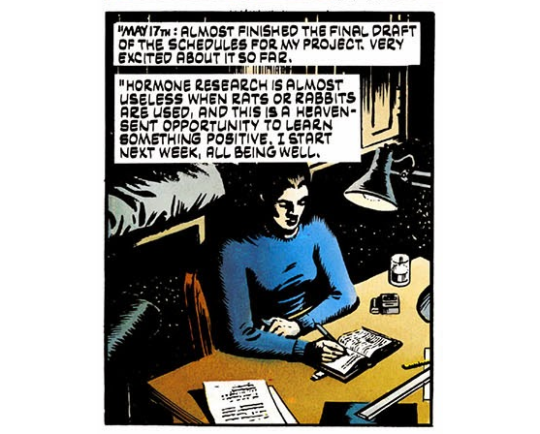
Why do I believe that theory? In addition to whole LGBT themes thing, and the letter thing, there’s one more reason. Well, I think this was skimmed by in the movie, but in the novel, we get a pretty solid clue. See, in the movie, exact nature of experiments performed on Larkhill inmates is kept rather dubious if I recall – we know they gave V abilities slightly above normal humans, but that’s it.
But in the novel, it’s more specific. So, what is the field of experiments that are being performed Larkhill concentration camp that they needed human specimen?
Hormone research.
V got strength to throw off chains of opression and fight back and yadda yadda, became a character who ticks off literally every single checkbox on definition of a superhero, including superpowers…
By literal fucking hormone therapy.
Administered to him, ironically, by the very oppressors.
From what I’ve read of Alan Moore’s stories, he doesn’t leave details up to a chance. Everything has a reason, and everything is interconnected with each other. And this, this doesn’t look like a bit of dark irony Alan Moore would pass up, since he loves that shit.
So, those are my reasons for this particular interpretation.
fandom please I implore you all to talk about Dean Thomas more
literally yelling for a red card during a Quidditch match
painting a potter for president banner for his friend HOW CUTE
offering to forge a signature so that same friend could go to the village with the rest of them
actually he paints banners supporting Harry on two separate occasions four years apart
is it weirder that he keeps doing that or that Harry keeps getting himself into situations where he requires banners
good with a quill be still my beating heart the boy is an artist
literally not giving a single fuck that their teacher was a “dangerous half-breed” because he respected the hell out of him as a person and educator
IF YOU MEAN PROFESSOR LUPIN, HE WAS THE BEST WE EVER –
and he grew up as a muggle so he had already been exposed to werewolf folklore and he had every excuse to be afraid or prejudiced and instead decided to judge him on a human level, even without the familiarity the trio etc. had to him
standing up for that same teacher time and time again
including to a ministry official who he just generally gave the sass to anyway
never losing his faith in Harry even when his very best friend in the whole world and approximately 89% of the wizarding community basically thought the bloke was a nutjob
convincing his best mate to join DA
there was a fair bit of an anti-dean sentiment in HBP best to ignore that then
never having any animosity towards his friend for getting together with his ex-girlfriend so soon
completely supporting and defending Harry while on the run because OBVIOUSLY why stop now after seven years of doing literally that at every single opportunity
being completely bemused by but always kind towards Luna
helping to dig the grave on the beach
running out into the final battle without a fucking wand
evidently winning one at some point
everything to do with him and Seamus however you want to view their relationship but frankly I could do a whole other post on that
“In Nepal, 150 people have been killed and 90,000 homes have been destroyed in what the UN has called the worst flooding incident in the country in a decade.
According to the Red Cross, at least 7.1 million people have been affected in Bangladesh – more than the population of Scotland – and around 1.4 million people have been affected in Nepal.
International aid agencies said thousands of villages have been cut off by flooding with people being deprived of food and clean water for days.”


 I'd Much Rather Have a Dragon