a lot of my friends have been noting that none of the “get out there and vote!” posts actually have any resources attached to them, so they’re great for motivation but if you don’t know how to vote they can really stress you out. so i compiled a list of resources that hopefully can help!
Here’s the most confusing bit! Figuring out who you’re voting for. Don’t know who’s running? Ballotpedia is a godsend. The page in the link looks very confusing, but all you have to do is click your state in each of the right-hand boxes. Those will take you to a page that will explain who from each party is running for the Senate and the House. Ballotpedia will also tell you if your state has same-day voter registration. If you’ve missed the cutoff to register, you might still be able to do it on election day, so check that on your state’s voting page!
Polling places can be crowded and the wait can be long to vote. Don’t freak out! Bring a book or some music/podcasts to listen to while you wait.
If you can’t make it on the day, you still have options! Find your state on this Ballotpedia page and click to learn more. The page it takes you to will have links and information on how to get an absentee ballot in your state. If you plan on absentee voting, hurry! The deadlines to apply and vote are usually sooner than the actual election day.
Most of all, remember: this election could swing the house and the senate, giving Democrats more control over new laws and legislation for years to come. You’re not a bad person if you can’t vote, but it’s a lot easier than you might think!
It’s often been remarked that Spider-Man’s schtick wouldn’t work nearly so well if he didn’t live in a town with so many tall buildings, but consider: how well would Batman’s “I am the night” routine work if he was operating out of a normal city where people actually live, rather than a perpetually twilit urban hellscape that looks like the Art Deco movement had a one-night stand with Soviet Brutalism in a wrought-iron-and-gargoyle factory?
That is my favorite description of the Batman aesthetic ever.
OMDFG that’s a perfect description.
Imagine Spiderman ballooning in wide open areas. No, sorry, can’t get to that crime, its against the prevailing wind.
Also, Batman brooding on top of a Wafflehouse.
Batman: God, this stupid city with its sufficient lighting and lack of crumbling infrastructure to shoot grappling hooks into
Superman: Everyone for miles has lead poisoning, I’ve spent the entire night stopping crossword puzzle museum robberies and heists at the Second National Bank of Gotham on the corner of second street and second avenue, and earlier the wall of…clouds? smog?…cleared up for a minute and I’m pretty sure the sky was literally blood red
Tumblr likes to spin its wheels and spend time yelling at each other, so here’s a nice comprehensive guide. Five Things You Can Do Now That You Know We Were Serious About The Antisemitism:
1) Accept that if you’re in this to be an ally, you’re going to have a tough road ahead of you. We’re traditionally very wary of outsiders in our spaces because when we welcome them, well … this happens. In fact, if you want to convert to Judaism, you traditionally get rejected three times, just to make sure you’re serious and not shitting with us. Expect wariness. Expect to get your feelings hurt, because a lot of us are very raw right now. Stick with us anyway–once we know you’re not just bandwagoning us, you’re going to end up with a lot of friends who are relying on you. Nobody said allyship was easy.
2) Learn about Judaism. Note that I DO NOT MEAN LEARNING WITH INTENTION TO CONVERT. We don’t proselytize and it would be against Torah for me to even suggest it. What I mean here is, you can’t call bullshit if you don’t know what we’re about. Some good basic resources are The Jewish Book of Why by Alfred Kolatch; My Jewish Learning; and for a strict Orthodox standpoint, Chabad. You’ll find that some things in these sources contradict each other. That’s pretty par for the course in Judaism; we don’t have a single dogma or point of view.
3) Consider calling a local synagogue and asking if they have volunteer work for a gentile ally. Introduce yourself, explain (briefly) what got your attention, and offer your services–to stand outside during services, to walk folks to and from shul (this is particularly important in Orthodox communities, where driving on Shabbat is forbidden), hell, to help stuff envelopes for whatever vigil or service they may be holding in memoriam. Anything will help.
4) You may wish to make a donation to a local synagogue or Jewish charity. I strongly recommend the ADL (Anti-Defamation League), which is a Jewish charity focused on combating antisemitism. Jews traditionally give monetary gifts in sums of $18, which corresponds to the numeric value of the word “chai,” or “life.” The last time this happened I made a post about this tradition and got accused of being a Nazi because of the whole 1-8 A-H thing, so let’s just nip that right in the bud: yes, we know. It’s a horrible coincidence. We’re not giving up a few-thousand-year-old tradition because of some dipshit with a bad moustache. If you can’t afford $18, consider moving the decimal over and donating in multiples of 18, like $3.60. Your meaning will still be perfectly clear, and anything helps. If you wish to make a donation in memory/in honor (which many synagogues appreciate), I suggest either choosing the name of one of the shooting victims–giving tzedakah, or charity, in their names is considered a great mitzvah and a blessing to their families–or using the phrase “am Yisrael chai.” It means “Israel lives.” Although the country in the MENA region is called Israel, this is not what the phrase refers to–the traditional patriarch of Judaism was named Jacob, and renamed as Israel following a wrestling match with a messenger of G-d. To say “am Yisrael chai” is to say his people, that is, the Jewish people, live.
And on that note …
5) In the coming days and weeks, you’re going to see a lot of people making this about Israel or Zionism. Please tell them to shut the fuck up. Israel, Zionism, and Jews are three completely different, albeit related, things. To wit: Israel is a geopolitical country situated on the site of our ancestral homeland and currently headed by Prime Minister Benjamin Netanyahu; Zionism is the belief that Jews deserve a safe homeland; and Jews are a group of people spread across six continents and most countries who are united by a common group of ancestors from the Levant (the part of the world now occupied by the geopolitical entity known as Israel). Saying the victims of this shooting had anything to do with the political situation in Israel would be like saying I, personally, am responsible for Vladimir Putin because I have a Russian ancestor. I speak exactly two words of Russian, have never been to Russia, have no family left living there (and haven’t for four generations), but I’m totally responsible for Russia. You see how ridiculous that sounds? The same applies to Jews and Israel. Please, please, PLEASE do not conflate this event with Israeli politics. I’m not saying Israeli politics aren’t a topic worth discussing–I’m saying this is not a discussion they belong in. Don’t let the powers that be (or the alt-right sleaze that sucks the dicks of the powers that be) distract from the topic at hand, which is “out of control guns meet out of control xenophobia and antisemitism,” by throwing OMG ISRAEL AND ZIONISM AND GLOBALISM into the mix.
And finally: yes, gentiles, this is okay for you to reblog. In fact I encourage it. And I will answer any questions you have to the best of my ability, if they’re asked in good faith. Please just follow the most basic tenet of Judaism, which is: don’t be a dick.
If you’re ready to stand and help, now is the time.
Don’t feel bad if you’re sensitive to negative feedback because apparently after one particular bad review Hans Christian Andersen was found just sobbing while lying face down in the dirt
YOU LEFT OUT THE BEST PART THOUGH! HE WAS CRYING FACE DOWN IN THE DIRT IN CHARLES DICKENSEN´S YARD!!
WHERE HE HAD BEEN STAYING FOR WEEKS, LONG OVERSTAYING HIS WELCOME, AND WAS ANNOYING THE FUCK OUT OF DICKENS
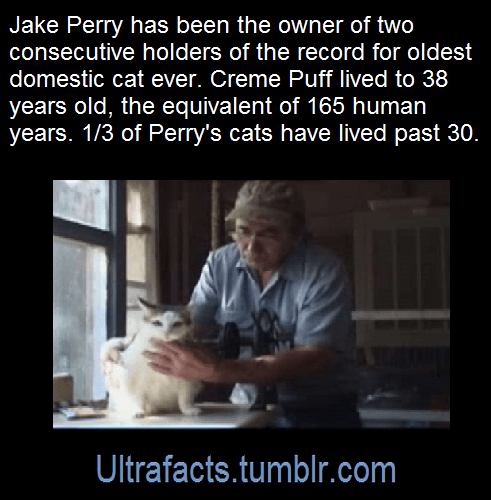
Okay so I went to the source article and here’s the paragraph where the guy tells his secret:
First, there was their daily diet: on top of dry commercial cat food, a home-cooked breakfast of eggs, turkey bacon, broccoli, coffee with cream, and—every two days—about an eyedropper full of red wine to “circulate the arteries.” Then there was his effort to ensure the cats were sufficiently stimulated: a garage he’d converted into a home movie theater, with a working reel-to-reel projector and actual movie theater seats, where Perry screens nature documentaries exclusively for the cats (with previews, he added). Last, and perhaps most important, he swore that love and close, personal relationships helped his cats live longer. Perry adored his cats so much, he remembered each of their birthdays.
hey I don’t think I’ve ever talked here about corn wolves. here let me find a gas station real quick
okay so I’m in the middle of nowhere stopped for gas in a small town in Iowa rn and my Internet is REALLY spotty so I hope this posts but
as people who have followed this blog for longer might know, sometimes I go hang out with this corn genetics lab at school, as in we meet up on friday nights to talk about corn science and stuff. once the corn genetics subject of the week is covered sometimes we go off track and start talking about other stuff. as u may imagine from a corn genetics lab, most of the members grew up on farms here in the midwest, and one night we were talking and a couple of the people started discussing an urban legend that they were taught as kids to keep them from running into their family’s cornfields and getting lost. one of those people was from Nebraska, and the other from rural minnisoda- these were isolated incidents of this urban legend happening, and all of us were deeply engrossed in this. i cannot make this shit up, this is the story:
there are wolves that live inside the corn when it’s full grown. they’re huge, and are camouflaged to hide in the fields. their breathing sounds like the misting of the irrigation systems set up over the corn in these areas for water. if they see small children in the fields, they kill and eat them.
now I’ve lived my whole life in suburban Iowa, and I can vouch that we don’t have irrigation systems like that here; our group came to the conclusion that this must be the reason that from our 7 or 8 person sample size, the corn wolves did not exist in Iowa, the largest producer of corn. I’ve never seen the corn wolves mentioned anywhere else outside that one night with the genetics lab, and it really fascinates me because as a horror/creepypasta person myself, I think it’s a great example of those strange little urban legends that never get written down on paper. the fact that it’s never appeared anywhere else in my life kind of confounds me, because it’s a really cool story. i like to go driving around rural Iowa when I’m home from college, and i always end up thinking about the corn wolves.
neither of the people believed it as kids btw lol
This is a FANTASTIC piece of Americana and cryptic lore. I propose making them a thing immediately.
Fun geography time.
This isn’t an unprecedented or unusual piece of folklore, and I think
there’s a notable demographic reason that this lore shows-up in the
long-grass prairies of the northern Corn Belt of the U.S. This appears
to be a classic telling of “Roggenwolf” folklore, a variation on the
“feldgeister” concept.
Roggenwolf – or sometimes, Kornwolf – specifically refers to the German folk belief in a phantom wolf spirit which hides in tall corn fields and stalks children. Roggenwolf is one of the more popular and widely-known of the feldgeister spirits.
In German folk culture, Feldgeisters, as is probably obvious from the name, are malevolent spirits which dwell in crops and rural agricultural fields. Feldgeisters
are almost always specifically associated with children; that is, they
are said to target children for torment and death. They are not really
associated with naturally-occurring grasslands or woodlands, but instead
are distinctly related to domesticated crops. Sometimes, some rural
residents will make small ritualistic offerings during harvest season as
a gesture to appease the spirit. The spirit is said to be most active
when crops are at their tallest.
Other variations of the crop-dwelling feldgeister include an evil pig (Roggensau); a dog that tickles children to death (Kiddelhunde); a witch-like corn-woman who kidnaps children (Roggenmuhme); and a chicken that pecks-out children’s eyes (Getreidehahn).
I
would say that there are two (2!) very good reasons why feldgeister lore shows-up in some micro-regions of the Midwest, while being absent
in others. Specifically, both the ethnic heritage and the ecology of a
certain part of the Plains/Midwest create good conditions for
replicating this European lore in North America
People familiar with the cultural
geography of the American Midwest are probably well-aware of the strong
ethnic Norwegian presence among rural agricultural cultures in the
glaciated plains of the Red River Valley of western Minnesota, the
northern half of North Dakota, and northeastern Montana. Ecologically,
this landscape is glaciated prairies with pothole lakes, and often hosts
much more barley than corn. Meanwhile, the Heartland region of rural
Illinois and Indiana, though hosting quite a bit of heavy corn industry,
isn’t too much more ethnically German than other parts of America, and
much of the landscape is a mixture of Rust Belt industrial areas
in-between the cornfields (so it’s not exactly desolate and creepy).
However,
there is very strong ethnic German presence in the long-grass prairies
southern Minnesota, South Dakota, south-central North Dakota, parts of
western Wisconsin, and central Nebraska and Kansas away from the urban
areas of Omaha and Kansas City. In most of this land, over 50% of the
population has German ancestry. Aside from this cultural composition,
this region also lends itself better to creepy, eerie stories because it
is more empty and ecologically homogenous than the rest of the Great
Lakes and Heartlands; this is the region where crops run uninterrupted
for miles and rural dirt-roads run in empty grid networks in every
direction. Though the feldgeister concept has a closer association with
cornfields in Europe, the long-grass prairies (roughly centered neared
Sioux Falls) host 1) heavy German influence, and 2) the most expansive
crops in the country. Therefore, the region is probably ripe for a
replication of spooky German lore about haunted cornfields.
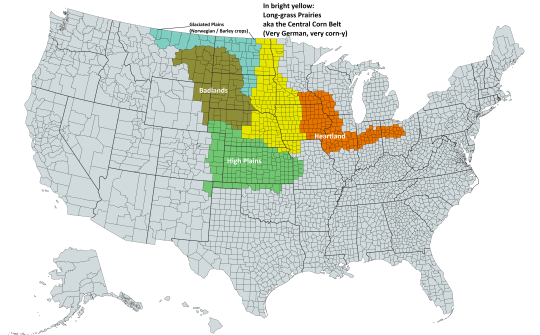
Source: Me Map 1 – Cultural Micro-Regions of the Heartland and Great Plains:
I think that this map might help to visualize where both cornfields and
rural lifestyle predominate, opening the door to rural folklore. The two
regions here where corn agriculture is predominant are the orange and
yellow regions. The orange region, the classic “Heartland”, hosts
Indiana Hoosier culture and the cornfields of Illinois and Ohio.
However, the region is marked by smaller farms and a higher population
density, and is not that rural compared to the plains further west; much
of this region also hosts larger cities and a lot of Rust Belt
industrial zones and dairy farms. The yellow region, however, is both
covered in corn and quite rural, where crops can span from horizon to
horizon. That’s where we would look for German folk culture.
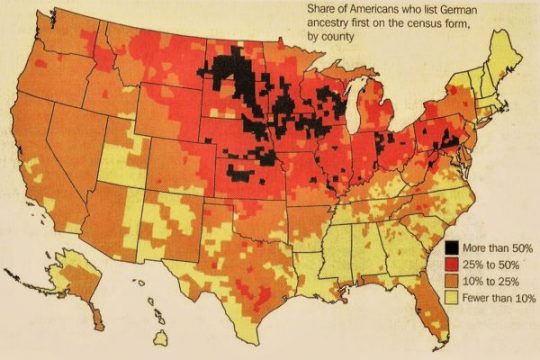
Source: An anonymous hero cartographer who’s had their work stolen by Pinterest users Map 2 – German Ancestry in the U.S.
This might help to visualize the places where predominant corn agriculture overlaps with German ancestry. Note that in much of central Wisconsin and central North Dakota, over 50% of people have German ancestry. But this land isn’t really dominated by corn. However, the region roughly from Fargo (on the Minnesota-North Dakota border) to Kansas City is both heavily German and dominated by corn. —
Anyway, feldgeister lore is scary. I’d love to hear more American versions, since a lot of the scholarship on these spooky corn-wolves is based on folk culture in Germany itself, rather than the diaspora in the U.S.
Saw this post about feldgeister’s going around again, so thought I’d make a low-effort re-post for anyone interested in “Midwestern gothic” or how local ecology influences regional folklore.
this an awesome hot take thank you!!
and just in time for halloween and the corn harvest, too 👀
this is the most exquisitely @seananmcguire blend of creepiness, scholarship, and corn that has ever existed.

















 I'd Much Rather Have a Dragon