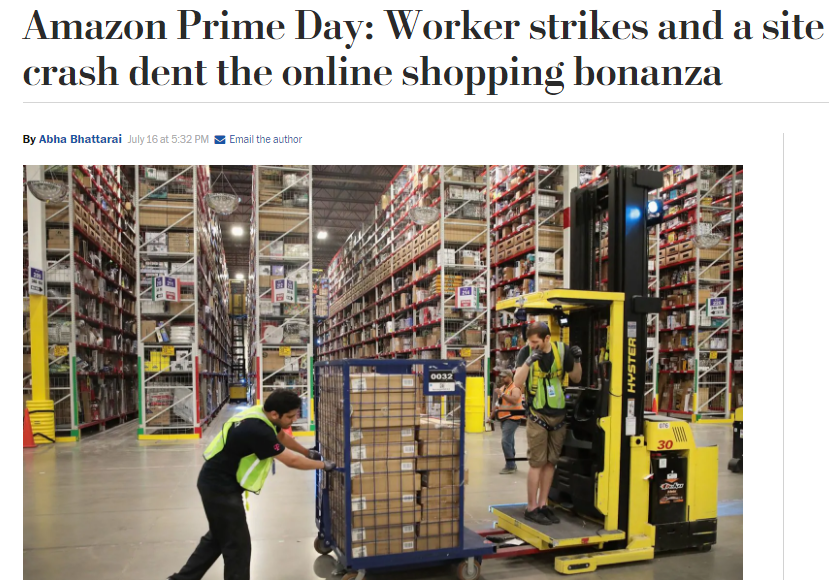
Thousands of workers all over the world have been striking leading up to and on Prime Day, Amazon’s biggest sale, calling for better working conditions, pay and health benefits.
Nearly 1,800 Amazon workers (96% of the workers at the San Fernando warehouse) in Spain went on strike Monday during Prime Day, the company’s biggest sales day of the year
Thousands more Amazon employees in Germany are expected to walk off the job Tuesday, the second day of the sale in six warehouses.
Amazon’s website and mobile app crashed for about 45 minutes, due to a computer glitch – the most widespread to date, costing Amazon millions of dollars
In the US, advocacy groups are planning several consumer rallies outside Amazon-owned Whole Foods Market locations to protest the sale of Nazi, Confederate and white nationalist merchandise through Amazon’s marketplace of third-party sellers.
Amazon is still expected to profit more this year than last year. Let’s hope we can keep spreading the word about the boycott and prove them wrong. Spain’s strike is supposed to last through the 18th, so keep boycotting
just to be clear; the misinformation about the dates wasn’t due to random claims pulled out of nowhere – at one point this was the ACTUAL time of the strike, it just changed in the course of negotiations
so again – don’t bite people’s head’s off for wrong information during unfolding current events. those details were true at one time. then changed. it’s in the spanish news. probably not in american news bc amazon owns everything here and bc america tends to ignore shit happening in europe. i used google translate to read spanish articles on the topic there’s a lot out there if you use key terms like “amazon
Really? This broad can’t think of one time Jesus got in trouble with the law? Like, once? Where it maybe led to a pretty significant consequence? Not once?
Coraline is a masterfully made film, an amazing piece of art that i would never ever ever show to a child oh my god are you kidding me
Nothing wrong with a good dose of sheer terror at a young age
“It was a story, I learned when people began to read it, that children experienced as an adventure, but which gave adults nightmares. It’s the strangest book I’ve written”
This is a legit psychology phenomenon tho like there’s a stop motion version of Alice and Wonderland that adults find viscerally horrifying, but children think is nbd. It’s like in that ‘toy story’ period of development kids are all kind of high key convinced that their stuffed animals lead secret lives when they’re not looking and that they’re sleeping on top of a child-eating monster every night so they see a movie like Coraline and are just like “Ah, yes. A validation of my normal everyday worldview. Same thing happened to me last Tuesday night. I told mommy and she just smiled and nodded.”
Stephen King had this whole spiel i found really interesting about this phenomenon about how kids have like their own culture and their own literally a different way of viewing and interpreting the world with its own rules that’s like secret and removed from adult culture and that you just kinda forget ever existed as you grow up it’s apparently why he writes about kids so much
An open-ended puzzle often gives parents math anxiety while their kids just happily play with it, explore, and learn. I’ve seen it so many times in math circles. We warn folks about it.
Neil Gaiman also said that the difference in reactions stems from the fact in “Coraline” adults see a child in danger – while children see themselves facing danger and winning
i never saw so much push back from adults towards YA literature as when middle aged women started reading The Hunger Games. They were horrified that kids would be given such harsh stories, and I kept trying to point out the NECESSITY of confronting these hard issues in a safe fictional environment.
SAGAL: No. I mean, for example, your incredibly successful young adult novel “Coraline” is about a young girl in house in which there’s a hole in the wall that leads to a very mysterious and very evil world. So when you were a kid, is that what you imagined?
GAIMAN: When I was a kid, we actually lived in a house that had been divided in two at one point, which meant that one room in our house opened up onto a brick wall. And I was convinced all I had to do was just open it the right way and it wouldn’t be a brick wall. So I’d sidle over to the door and I’d pull it open.
(SOUNDBITE OF LAUGHTER)
SAGAL: Right.
GAIMAN: And it was always a brick wall.
SAGAL: Right.
GAIMAN: But it was one of those things that as I grew older, I carried it with me and I thought, I want to send somebody through that door. And when I came to write a story for my daughter Holly, at the time she was a 4 or 5-year-old girl. She’d come home from nursery. She’d seen me writing all day. So she’d come and climb on my lap and dictate stories to me. And it’d always be about small girls named Holly.
SAGAL: Right.
GAIMAN: Who would come home to normally find their mother had been kidnapped by a witch and replaced by evil people who wanted to kill her and she’d have to go off and escape. And I thought, great, what a fun kid.
“Fairy tales do not give the child his first idea of bogey. What fairy tales give the child is his first clear idea of the possible defeat of bogey. The baby has known the dragon intimately ever since he had an imagination. What the fairy tale provides for him is a St. George to kill the dragon.” – G. K. Chesterton

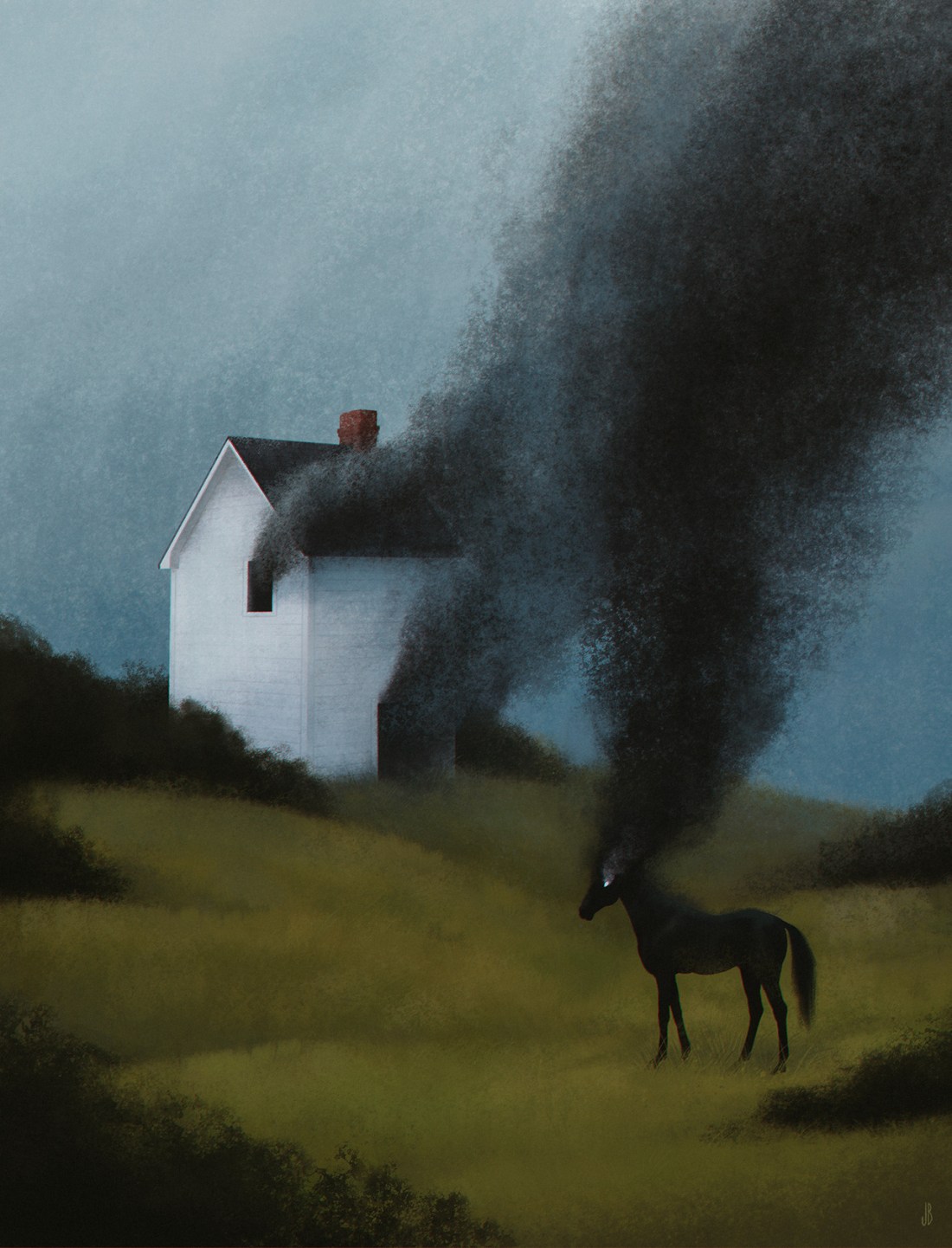





 I'd Much Rather Have a Dragon