The thing was, Henrietta looked like a place where magic could happen. The valley seemed to whisper secrets. … At night, Henrietta felt like magic, and at night, magic felt like it might be a terrible thing.
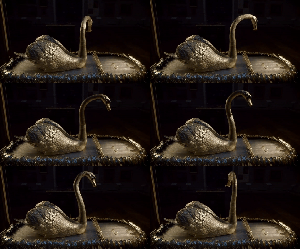
oh wow, the “water” is an illusion created by spinning glass rods.
wooooooooooah
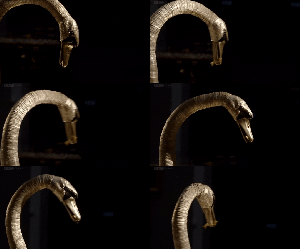
Always reblog the clockwork swan
This post is like a school trip flash back for me, must have seen that swan a dozen times as a kid. It still takes my breath away
“When I was about 20 years old, I met an old pastor’s wife who told me that when she was young and had her first child, she didn’t believe in striking children, although spanking kids with a switch pulled from a tree was standard punishment at the time. But one day, when her son was four or five, he did something that she felt warranted a spanking–the first in his life. She told him that he would have to go outside himself and find a switch for her to hit him with.
The boy was gone a long time. And when he came back in, he was crying. He said to her, “Mama, I couldn’t find a switch, but here’s a rock that you can throw at me.”
All of a sudden the mother understood how the situation felt from the child’s point of view: that if my mother wants to hurt me, then it makes no difference what she does it with; she might as well do it with a stone.
And the mother took the boy into her lap and they both cried. Then she laid the rock on a shelf in the kitchen to remind herself forever: never violence. And that is something I think everyone should keep in mind. Because if violence begins in the nursery one can raise children into violence.”
Astrid Lindgren, author of Pippi Longstocking, 1978 Peace Prize Acceptance Speech (via i-contain-multitudes)
Percy Bysshe Shelley’s Ozymandias was first published in the 11 January 1818 edition of The Examiner – 200 years ago today.
Ozymandias is the Greek name for Ramses II, who ruled Egypt from 1279 to 1213 BC. He was a military conqueror and a great builder, but Shelley’s sonnet describes how the achievements of even the mightiest tyrants are obliterated by time.
Ironically, the imagery in Shelley’s poem is very much still part of the cultural conversation, two centuries after first publication. For one recent example, it seemed like Blade Runner 2049 had images deliberately designed to evoke Shelley’s ideas.
This manuscript draft of the sonnet is kept in the Bodleian Libraries’ collection with the shelfmark MS. Shelley e. 4
You can read more about Ozymandias, and the other work of Shelley, on our Shelley’s Ghost website, originally built to support our 2010-11 exhibition.




















 I'd Much Rather Have a Dragon